
Have you ever felt like you’re stuck in a loop with your finances? It’s a classic frustration: you want to build credit so you can eventually qualify for a mortgage, a car loan, or a better apartment, but to get a credit card, you usually need… well, good credit. It’s the ultimate “Catch-22” of the American financial system.
For many of us, the traditional path to building credit is paved with obstacles. You apply for a card, get hit with a “hard” credit check that actually lowers your score, and then get rejected anyway. Or, you’re forced to look at a secured credit card that demands a $500 deposit upfront—money that many people simply don’t have sitting around—and charges high interest rates and annual fees just for the “privilege” of using your own money.
It feels like the deck is stacked against you. But what if there was a way to break that cycle without the predatory fees or the anxiety of a credit check? That’s exactly where the Chime Credit Builder Visa® Credit Card comes in. It’s a modern solution designed to help you take control of your financial future on your own terms.
What is the Chime Credit Builder Card?
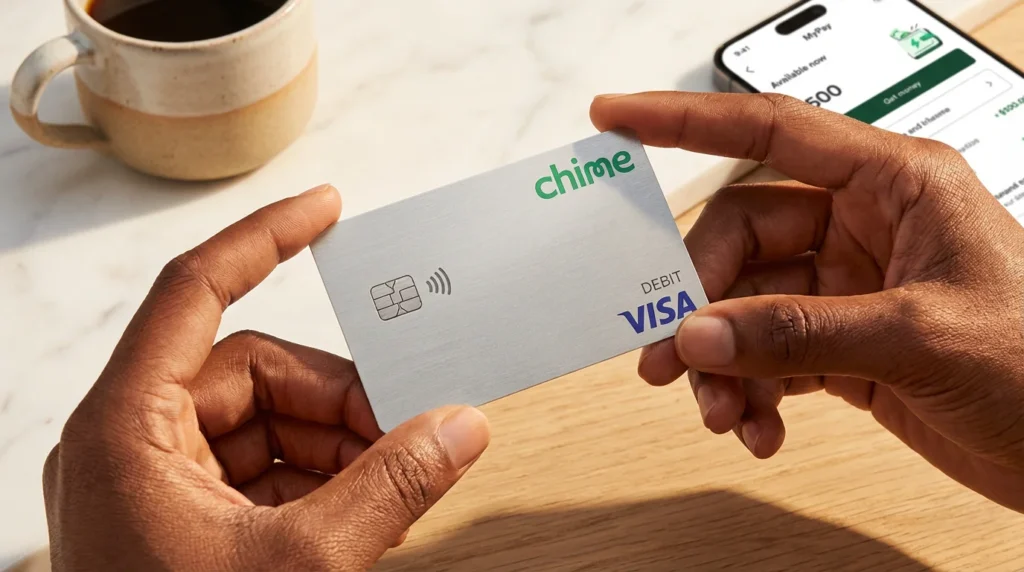
Chime isn’t a bank; it’s a financial technology company that has flipped the script on how credit building works. Their Credit Builder card is a secured credit card, but it doesn’t act like the ones your parents might have used. Instead of a fixed deposit that stays locked away in a vault, you decide how much you want to spend by moving money from your Chime Checking Account into your Credit Builder account. That amount becomes your spending limit.
Let’s dive into the four reasons why this card is a game-changer for anyone looking to build credit from scratch or rebuild after a few financial bumps in the road.
1. No Credit Check to Apply
One of the biggest barriers to entry with traditional cards is the “hard pull” on your credit report. If your score is already low, a hard inquiry can feel like a setback you didn’t need. Chime removes this hurdle entirely. There is no credit check to apply, meaning you can start your journey without the fear of a rejection letter or a dip in your current score.
2. No Interest and No Annual Fees
Most credit cards make their money when you fail—when you carry a balance and they hit you with 19% to 25% interest. Chime has taken a different approach. The Credit Builder card is a no interest credit card (0% APR). Plus, there’s no annual fee. You aren’t being charged for the right to build your credit; you’re just using a tool that works for you, not against you.
3. No Minimum Security Deposit
Traditional secured cards often require a minimum deposit of $200 or more. If you’re living paycheck to paycheck, that’s a huge ask. With Chime, there is no minimum security deposit. You can move $20, $50, or $100—whatever fits your budget. You spend what you load, so you’re always in the driver’s seat of your spending.
4. Reporting to All Three Bureaus
The whole point of a credit-building tool is to make sure the right people see your progress. Chime reports your on-time payments to all three major credit bureaus: Equifax, Experian, and TransUnion. Consistent, on-time payments are the single biggest factor in your credit score. In fact, Chime members saw an average 30-point FICO® Score increase with regular on-time payments, according to a January 2024 Experian study.
How Chime Compares to the Competition
When you look at the landscape of credit-building tools, the differences become even clearer. Many traditional cards lure you in with “easy” approval but then trap you with “junk” fees. Here is how Chime stacks up against the traditional options:
| Feature | Chime Credit Builder | Traditional Secured Card | Traditional Credit Card |
|---|---|---|---|
| APR | 0% (No interest) | ~19% Variable | 12-17% Variable |
| Annual Fee | $0 | $0 – $59 | $0 – $550 |
| Security Deposit | No minimum | $200 – $500 required | None |
| Credit Check | None | Hard pull | Hard pull |
A Smarter Way to Build
One of the most unique features of the Chime Credit Builder card is how it handles “credit utilization.” On a standard credit card, if you have a $500 limit and you spend $450 of it, your “utilization” is 90%. Even if you pay it off perfectly, that high utilization can actually lower your credit score.
Chime is different. Because it is a secured credit card that you load yourself, Chime does not report credit utilization to the bureaus. They only report your on-time payments. This removes the “utilization trap” and lets you use the card for daily purchases—like gas or groceries—without worrying about how it looks on your credit report.
To make things even easier, Chime offers a feature called Safer Credit Building™. When you turn this on, Chime automatically pays your monthly balance using the money you already moved into your Credit Builder account. It’s like putting your credit score on autopilot.
Getting Started is Simple
The process to start building is straightforward. You don’t have to jump through hoops or wait weeks for a decision. Here is the path to better credit:
- Sign up: It takes about 2 minutes to apply, and remember, there is no credit check. (Note: You’ll need a Chime Checking Account to get started).
- Move money: Transfer funds from your Chime Checking Account to your Credit Builder account. This is your spending limit.
- Use the card: Use it anywhere Visa is accepted—online, in-store, or for your monthly subscriptions.
- Build: Chime reports your on-time payments to all three bureaus, helping you build a positive history.
Beyond credit building, Chime members also enjoy perks like SpotMe®, which provides fee-free overdraft protection from $20 to $200+ on qualifying direct deposits, and access to over 47,000 fee-free ATMs. You can even get your paycheck up to two days early with direct deposit.
Final Thoughts
Building a solid financial foundation shouldn’t feel like an uphill battle. If you’ve been held back by high deposits, interest rates, or the fear of a credit check, the Chime Credit Builder card offers a refreshing, transparent alternative. It’s about more than just a piece of plastic; it’s about giving yourself the tools to move forward with confidence.
Chime is a financial technology company, not a bank. Banking services and debit card provided by The Bancorp Bank, N.A. or Stride Bank, N.A., Members FDIC; Credit Builder card issued by Stride Bank, N.A.
The Chime Credit Builder Visa® Credit Card is a secured credit card. To apply, you must have an active Chime Checking Account. The money you move to Credit Builder is the amount you can spend on your card.
Based on a study conducted by Experian®, members who made their first on-time payment between June 2022 and October 2022 and had no previous late payments saw an average increase of 30 points in their FICO® Score 8 within eight months. Individual results may vary.
SpotMe® on Debit is an optional, no fee service that requires a single deposit of $200 or more in qualifying direct deposits to the Chime Checking Account each month. All qualifying members will be allowed to overdraw their account up to $20 on debit card purchases and cash withdrawals initially, but may be later eligible for a higher limit of up to $200 or more based on Chime account history, direct deposit patterns and other risk-based factors.









Leave a Reply